End-Range Strength Versus Passive Flexibility in Yoga Classes
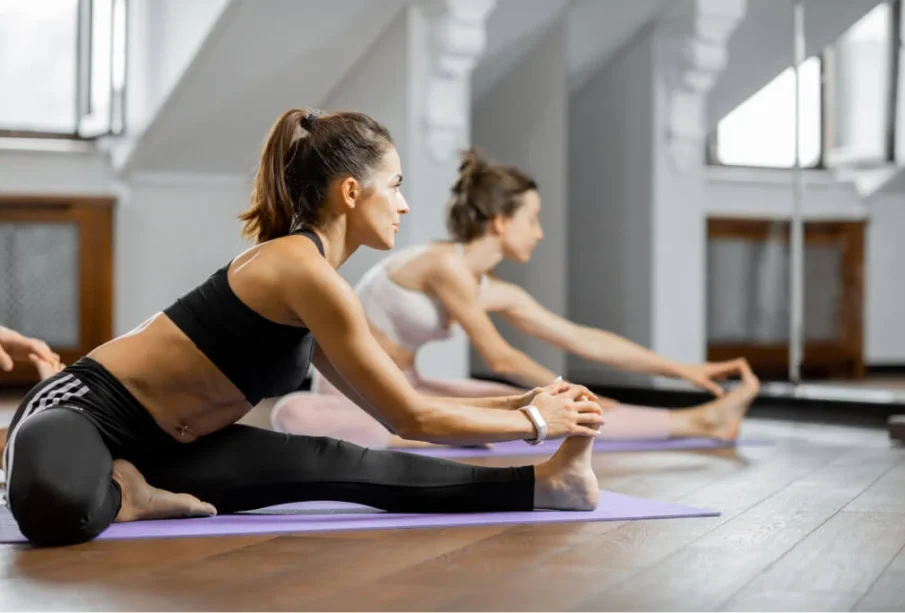
Flexibility is one of the qualities most commonly associated with yoga, but reaching a position and controlling it are not the same skill. A practitioner may be able to use gravity, a strap or another person’s assistance to enter a deep shape yet feel unstable when asked to move into or out of that range without support.
Well-structured yoga classes can develop more than passive range. They can teach practitioners to produce force near the edges of comfortable movement, coordinate joints under load and decide when greater range is actually useful.
What Passive Flexibility Actually Describes
Passive flexibility is the range available when an external force helps create the position. Gravity may draw the torso towards the legs, a strap may pull the foot closer, or the floor may support the body in a deep hip shape. Passive work can be relaxing and can help a practitioner explore sensations without producing much muscular effort.
It is not inherently inferior to active movement. The problem arises when passive depth becomes the only measure of progress. A person may appear highly flexible while lacking confidence, strength or coordination in the same range during standing and transitional movements.
End-Range Strength Has a Different Purpose
End-range strength refers to the ability to create and control force near the current limit of a joint’s comfortable movement. It does not mean contracting as hard as possible in an extreme pose. The range should remain appropriate to the individual and the task.
Examples include lifting a straight leg without pulling it closer by hand, holding the arms overhead without arching excessively through the lower back, or rising from a deep squat with control.
More Range Is Not Always the Missing Ingredient
A practitioner who struggles in a pose may assume that tight muscles are responsible. Sometimes the limitation is related to strength, balance, joint structure, confidence or the way the movement is being taught. Stretching harder may not address any of these factors.
An instructor can help distinguish between a range that is not currently available and one that is available but difficult to control. That difference changes the strategy. The first may benefit from gradual mobility work, while the second may need reduced-range strength and clearer movement practice.
Joint Structure Influences the Shape
People do not share identical bone proportions, joint orientation or tissue characteristics. Two practitioners can receive the same cue and produce visibly different poses without either being incorrect. Some end positions are limited by anatomy rather than a stretchable muscle.
This is why forcing every body towards a standardised photograph can be counterproductive. Props, stance changes and smaller ranges allow practitioners to work with their structure. Good teaching focuses on the purpose of the pose, not cosmetic uniformity.
Active Mobility Connects Flexibility and Strength
Active mobility is the range a person can access through muscular effort and control. It sits between passive stretching and conventional strength work. Slow leg lifts, controlled spinal articulation and deliberate transitions are common ways to develop it.
The active range will often be smaller than the passive range. That gap is normal. Training can gradually reduce it, but the goal is not to make both measurements identical. It is to create enough control for the movements a practitioner wants to perform.
Use Isometric Work Near the Edge
An isometric contraction creates muscular effort without obvious movement. Near an end range, it can teach the body to stabilise a position. A practitioner might press the heel gently into the floor during a hamstring-focused pose or press the hands into blocks while holding a low lunge.
The effort should be scaled so that breathing remains controlled and the intended position does not collapse. Short contractions followed by rest are often enough. High effort is not necessary for every session, particularly when the body is fatigued.
Slow Transitions Reveal Control
Moving slowly into and out of a pose removes momentum and exposes where control becomes uncertain. A slow descent from standing into a lunge, for example, may show that the practitioner can hold the final pose but struggles during the transition.
That information is useful. The range can be reduced, support added and the difficult portion repeated with good form. Progress is then measured by smoother control rather than by pushing the final shape deeper.
Balance Poses Are End-Range Tests Too
Balance requires the body to organise range, strength and sensory information at the same time. In standing hand-to-foot poses, a practitioner may be able to stretch the leg high with a strap but unable to keep it there after releasing the support.
Keeping the knee bent or the leg lower allows active control to become the focus. A wall can reduce the balance demand while the hip works. These adjustments make the pose more specific, not less advanced.
Strength Can Protect Against Uncontrolled Collapse
Strength does not make a person injury-proof, and flexibility does not make a person fragile. Still, having the capacity to slow or reverse a movement is useful when balance shifts or a transition does not go as planned.
End-range work can improve this braking ability. The practice should remain progressive because tissues need time to adapt to new loads. Sudden high-force effort in a newly accessed range may exceed current capacity even if the position feels available.
Hypermobility Requires Thoughtful Loading
People with naturally large ranges may receive frequent praise in yoga settings, yet they can still feel unstable or uncomfortable. They may benefit less from continually seeking depth and more from learning where to stop, how to generate tension and how to use mid-range positions.
General advice cannot replace assessment for symptomatic hypermobility. In class, clear boundaries, slower pacing and strength-oriented variations can help. The practitioner should not be pressured to demonstrate maximum range simply because it is visually available.
Warmth Changes Sensation, Not Anatomy
A warm room or active sequence may make the body feel more mobile. Increased temperature and familiarity with movement can reduce resistance and change perceived stiffness. That does not mean joint structure has changed or every newly available position should be loaded deeply.
Practitioners can use warmth to move comfortably while retaining the same control standards. If a range is accessible only when momentum, leverage or intense heat is present, it may not yet be ready for demanding strength work.
Match the Method to the Goal
A restorative class may use supported passive positions because relaxation is the objective. A strength-oriented class may emphasise active lifts and controlled transitions. Neither method has to replace the other.
Across a balanced week, practitioners can experience passive release, active mobility and progressive strength. The proportion should reflect their goals, other training and recovery. Someone who already stretches extensively may need more controlled loading, while a heavily trained athlete may value gentle supported range.
Ask Better Questions About Progress
Instead of asking only whether a pose is deeper, consider whether breathing remains steady, entry and exit feel smoother, and the range is available without excessive force. These signs provide a broader picture of movement quality.
When choosing sessions at Yoga Edition, practitioners can review class descriptions and ask whether the teaching includes active mobility, strength and appropriate variations. The right class should make the purpose of an exercise clear rather than equating visible flexibility with success.
Build Range That the Body Can Use
Passive flexibility can be calming and useful, while end-range strength makes movement more controllable. A mature practice does not need to choose one side. It applies each method where it serves a clear purpose.
Progress may mean lifting a leg lower but with better control, leaving a stretch before discomfort or using a block to create a stronger position. These choices produce movement that is not only available on the mat, but usable beyond it.
Frequently Asked Questions
Is passive stretching bad for yoga practitioners?
No. Passive stretching can support relaxation and range exploration. It becomes less useful when it is forced, painful or treated as the only form of mobility training.
How can I tell whether I control my flexibility?
Compare a supported position with the range you can reach and hold using muscular effort. A difference is normal, but a very large gap may identify an area for active work.
Should end-range strength exercises feel intense?
They can create clear muscular effort, but they should not cause sharp pain, pinching, numbness or loss of control. Intensity should build gradually.
Can strength training make me less flexible?
Not automatically. Strength work performed through suitable ranges can maintain or improve mobility. Programme design, recovery and individual response matter.
Do flexible people need mobility training?
They may benefit from active mobility and stability work rather than pursuing more passive depth. The appropriate focus depends on control, symptoms and goals.
How often should end-range strength be practised?
It can appear in two or three weekly sessions, depending on effort and other training. Higher-load work needs recovery, while light control exercises may be used more frequently.